
Last updated October 16, 2026
 Wrought iron
 Wood & steel frame
 Farm & ranch
 Sliding driveway gates
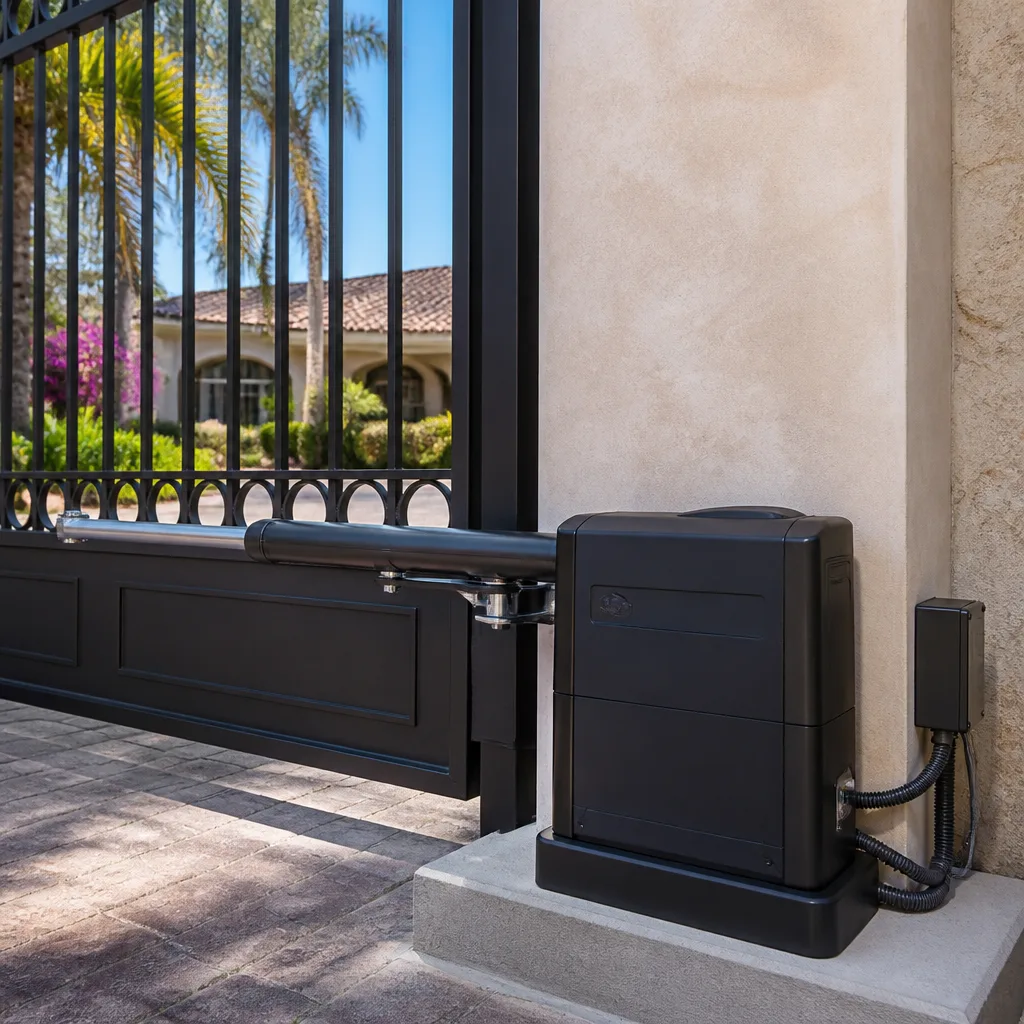 LiftMaster operators
Free on-site gate assessment - hinges, posts, and your LiftMaster or Nice gate operator checked before anything is quoted
The assessment is free and the quote is the invoice.
Get your free estimateDIY vs Professional Gate Repair: The Orlando Homeowner’s Decision Guide
Here’s the number most Orlando homeowners never hear: a UL 325 entrapment failure on a residential gate is cited in hundreds of injury claims nationwide each year, and almost none of those gates were installed by amateurs. They were adjusted by them. A gate that slides off its track is annoying. A gate that reverses force because a well-meaning homeowner turned a trim pot one click too far is a different category of problem entirely. This guide walks through which gate repairs belong in the DIY column, which belong in the professional Gate Repair column, and why the dividing line in Orlando has less to do with saving money than with what happens when the repair fails. You’ll learn the real cost difference on the five most common repairs, what UL 325 actually requires, and where the manufacturer’s fine print quietly voids your warranty the moment you open the control panel.
Styles & brands we work with
Quick Answer
Most Orlando homeowners can safely handle cosmetic and non-mechanical gate repairs: remote batteries, track cleaning, hinge lubrication, and tightening loose hardware. Repairs involving the operator, force-sensing, entrapment protection, or any component governed by UL 325 should always be handled by a professional, because a mistake creates either a safety hazard or a voided warranty. The cost of a professional repair is often 40 – 60% higher than parts alone, but that difference buys a written guarantee and removes the homeowner from the liability chain.
Table of Contents
- The Real Divide: Safety Threshold, Not Skill
- UL 325 Explained Plainly: What It Regulates and Why It Matters
- Five Gate Repairs a Careful Orlando Homeowner Can Handle
- Five Gate Repairs That Belong With a Professional
- Why Orlando’s Humidity Makes DIY Gate Repair an Uneven Bet
- The Real Cost Comparison: Parts-Only vs Professional on Five Common Repairs
- The Warranty Fine Print Most Homeowners Never Read
- Common Mistakes to Avoid
- When to Call a Professional
- Frequently Asked Questions
- The Bottom Line
The Real Divide: Safety Threshold, Not Skill
The DIY-versus-professional conversation usually starts with money. That’s the wrong starting point for gate repair. An automated driveway gate is classified as moving machinery under Florida building code, and the standards governing it, specifically UL 325, exist because gates have injured and killed people. Not hypothetically. The Consumer Product Safety Commission has tracked entrapment deaths and serious injuries on automated gates since the 1990s, which is why the current safety standard exists in the first place.
So the honest dividing line is not “Can I figure this out?” It’s “If I get this wrong, what’s the worst outcome?” For a squeaky hinge, the worst outcome is a squeak. For an open-force limit that’s set too high, the worst outcome is a gate that doesn’t stop when it should. That’s the difference in one sentence: cosmetic and mechanical repairs belong in one column. Anything touching force, speed, entrapment protection, or the operator’s control board belongs in the other.
We’ve seen this play out in Orlando neighborhoods from Dr. Phillips to Winter Park. A homeowner watches a ten-minute video, opens the control panel on a Linear or Viking operator, turns an adjustment screw a quarter turn, and now the gate closes with enough momentum to dent a car bumper. Or the gate stops mid-travel twice a day and the homeowner can’t figure out why. The video didn’t mention the safety edges. The video didn’t mention the photo eyes. The video didn’t mention that the setting they just changed interacts with two other settings they’ve never heard of.
That’s not a knock on homeowners. It’s a statement about what gate repair actually involves. The mechanical part, the part you can see, is simple. The control side, the part you can’t see, is where the risk lives.
UL 325 Explained Plainly: What It Regulates and Why It Matters
UL 325 is a safety standard published by Underwriters Laboratories that governs automated gate operators and other power-operated doors. In plain terms, it sets the rules for how an automated gate must behave when something, or someone, is in its path. It covers two main hazards: entrapment and impact. Entrapment is what happens when a gate pinches, crushes, or holds a person or object. Impact is what happens when a moving gate simply hits someone hard enough to cause injury.
Every automated gate installed or repaired in Florida is expected to comply with UL 325, which the Florida Building Code references directly. The standard requires entrapment protection on every automated gate. That protection comes in two forms:
- Type A: Inherent entrapment protection – the operator itself senses an obstruction through force monitoring or speed monitoring and reverses or stops the gate. This is built into the control board and adjusted through settings like open-force and close-force limits.
- Type B: External entrapment protection – devices like photo eyes, contact edges, or edge sensors that detect an obstruction independently of the operator and signal it to stop or reverse.
Here’s the part most DIY tutorials skip: UL 325 requires that a gate operator be tested after any adjustment to force or speed settings. Not visually inspected. Tested. Specifically, the gate must reverse or stop when it encounters a solid object, and the force exerted must fall below a maximum threshold. A professional gate repair technician in Orlando carries a force gauge for exactly this purpose. The gauge measures the force in pounds at the leading edge of the gate and at entrapment points along the travel. If the number is too high, the repair isn’t done, no matter how smoothly the gate moves.
A homeowner adjusting an actuator, which is the motorized arm that physically pushes a swing gate open and closed, has no force gauge. They’re adjusting by feel and sound. That’s not a criticism of competence. It’s a statement about equipment. The adjustment isn’t complete without the measurement, and the measurement isn’t possible without the tool. This is the real reason force-sensing adjustments belong in the professional column: compliance is a physical measurement, not a visual judgment.
Five Gate Repairs a Careful Orlando Homeowner Can Handle
Here’s the honest list of gate maintenance and repair tasks a careful homeowner in Orlando can do safely without a professional-our Gate Repair Maintenance Checklist for Orlando Homeowners covers these in full. These tasks don’t involve the operator, don’t involve wiring, and don’t touch any UL 325-governed component. They require basic tools and patience, and a mistake on any of them produces an annoying result, not a dangerous one.
- Remote control battery replacement. If the remote’s range is shrinking or you’re pressing the button twice to get a response, the battery is almost always the culprit. Slide the cover off, check the battery type (usually a CR2032 or A23), and swap it. If a fresh battery doesn’t fix it, the remote itself may need replacing, and that’s a good moment to call a professional so the new remote gets programmed correctly.
- Track cleaning and debris removal on slide gates. Slide gates in Orlando collect debris, sand, leaves, and the occasional lizard. A stiff brush and a few minutes of clearing the track can fix a gate that’s grinding or hesitating. Don’t use a pressure washer on the track. Don’t introduce grease into a chain-drive track unless the manufacturer calls for it. Just clear it and test.
- Hinge lubrication on swing gates. A squeaking hinge on a swing gate is a maintenance issue, not a repair. Use a lithium-based grease or a dry lubricant designed for metal-on-metal contact. Apply it, work the gate back and forth, and the squeak should fade. If it doesn’t, the hinge may be worn and a professional should look at the weight-bearing joints.
- Visual inspection of the gate, hinges, and posts. Every Orlando homeowner with an automated gate should do a slow walk-around once a month. Look for rust spots, cracks at weld points, loose bolts, sagging gate leaves, and anything hanging from the gate that shouldn’t be there. Catching a rust spot in month one is much cheaper than replacing a gate leaf in year three.
- Photo eye lens cleaning. Photo eyes, the small sensor units mounted on either side of the gate opening, get dirty in Orlando’s humidity and pollen. A soft cloth and a gentle glass cleaner will do. If cleaning the lens doesn’t restore function, don’t start adjusting the sensors. That crosses into alignment territory, which is a professional job.
One note on lubrication and cleaning: the goal is to keep the mechanical parts moving freely, not to “tune up” the operator. The operator doesn’t need tuning. If the gate is binding, the problem is usually mechanical, not electrical, and the fix is usually alignment or hardware, not turning adjustment screws.
Five Gate Repairs That Belong With a Professional
These are the repairs where a mistake creates either a safety hazard, a voided warranty, or a much larger repair bill. In our experience at Portcullis Gate Repair Orlando, these five account for the majority of “it worked for a week and then stopped” calls we receive after a DIY attempt.
- Actuator replacement on a swing gate. The actuator, the motorized arm that physically pushes the gate open and closed, is the workhorse of a swing gate system. Replacing one means disconnecting the gate from the operator, removing the old unit, mounting the new one in the correct position, and then setting the travel limits. The travel limits determine how far the gate opens and closes, and they also interact with the force-sensing system. Set the close limit too aggressively and the gate will drive past the closed position. Set the force limit too high and the gate will hit rather than stop. This is a professional repair on every swing gate brand, from Linear to DoorKing.
- Control board diagnostics and replacement. The control board is the circuit brain inside the operator. When a gate won’t open, opens on its own, or refuses to respond to any input, the board is the prime suspect. Diagnosing a board failure requires a multimeter, an understanding of the low-voltage circuits feeding the board, and a working knowledge of the specific operator’s fault codes. Replacing a board on a Viking or Ghost Controls operator isn’t a matter of unplugging the old one and plugging in the new one. The new board has to be configured for the specific installation, including the type of gate, the weight of the gate, and the entrapment protection devices. One misstep and the gate won’t operate at all, or worse, it operates unpredictably.
- Safety edge and photo eye replacement or alignment. Safety edges, the pressure-sensitive strips mounted on the leading edge of a gate, degrade over time. Orlando’s heat and humidity accelerate that degradation. Replacing a safety edge means routing the wiring through the gate, connecting it to the operator, and then testing it under load. Photo eye alignment is similarly precise: the two sensors have to see each other perfectly, and a fraction of an inch of misalignment will cause the gate to refuse to close. Both of these are UL 325 entrapment protection devices, which means both should have a professional sign-off after installation.
- Spring or counterweight replacement on a heavy gate. Some swing gates and slide gates use springs or counterweights to balance the gate’s weight. When a spring breaks on a heavy steel gate, the gate suddenly becomes much heavier and much harder to move. Replacing a gate spring is a job for a professional with the right tools and the right method, and attempting it without both can result in a gate that slams shut, a finger injury, or a broken weld. This is one of the most common injuries we hear about from well-intentioned DIY attempts in Orlando.
- Any repair on a gate that protects a pool or driveway used by children. A gate that encloses a pool area carries a different level of responsibility. Florida law requires pool barriers to meet specific standards, and an automated gate that fails to close properly can create a serious hazard. If the gate protects a pool, a child’s play area, or a driveway where kids ride bikes, treat it as a professional repair, full stop. The stakes are too high to experiment.
Why Orlando’s Humidity Makes DIY Gate Repair an Uneven Bet
Orlando’s climate is one of the hardest in the country on gates. The combination of heat, humidity, and regular afternoon thunderstorms creates conditions that accelerate rust, degrade seals, and shorten the life of exposed wiring. A DIY repair that would last five years in Phoenix might last eighteen months in Orlando. That’s not a guess. It’s the difference between a dry climate and a subtropical one, and it changes the math on every repair decision.
The specific problem is rust creep. When a homeowner in Orlando finds a rust spot on a gate leaf, the natural instinct is to sand it, prime it, and paint it. That works on a car door. It works less reliably on a gate, because the rust on a gate often starts inside a joint, a weld, or a hinge, where you can’t reach it with sandpaper. You can paint over the outside, but the rust continues underneath, and in Orlando’s humidity, it continues quickly. Six months later the rust spot is back, bigger than before, and the paint has started to bubble.
A professional doesn’t just paint over the rust. A professional grinds it out, treats the metal, and then seals it. In a case where the rust has compromised the structural integrity of the gate leaf, a professional will tell you that before the repair, not after. If you’re in College Park or Baldwin Park and your gate has visible rust at the weld points, that’s a bad sign. It means the rust is likely worse on the inside than the outside, and a surface repair will fail faster than the original rust appeared.
The same principle applies to seals and gaskets. The rubber seals around an operator housing degrade faster in Orlando than in most of the country because of the temperature swings and UV exposure. When a seal fails, moisture enters the operator. Moisture in an operator means condensation on the control board, and condensation on the control board means intermittent faults that are nearly impossible for a homeowner to diagnose. The operator works fine when it’s dry and fails mysteriously after a rainstorm. That pattern, working fine until it rains, is the classic Orlando signature of a compromised operator seal.
For a homeowner, the lesson is simple: in Orlando, a temporary fix is more temporary than it would be elsewhere. The math that makes a cheap DIY repair appealing assumes the repair will last. In this climate, that assumption is often wrong, and the repair cost ends up higher than if it had been done correctly the first time.
The Real Cost Comparison: Parts-Only vs Professional on Five Common Repairs
Here’s the honest cost comparison on the five gate repairs Orlando homeowners search for most. The “parts only” number reflects what a first-timer would pay at a hardware store or online retailer for the part alone. The “professional” number reflects what a Portcullis Gate Repair Orlando technician in Orlando would typically charge, including parts, labor, and the written Kingswell Guarantee. The time estimate is for a first-timer working alone, without the specialized tools a professional carries.
| Repair | Parts-Only DIY Cost | Typical DIY Time | Professional Cost Range |
|---|---|---|---|
| Remote control replacement | $15 – $45 (remote) or $2 – $6 (battery) | 10 minutes | $45 – $120 (includes programming) |
| Photo eye cleaning or replacement | $5 (cleaning supplies) or $35 – $80 (new photo eye) | 30 minutes to 2 hours | $95 – $220 (includes alignment and testing) |
| Swing gate actuator replacement | $180 – $450 (actuator only) | 3 – 6 hours | $550 – $900 (includes limit setting and force testing) |
| Control board replacement | $90 – $250 (board only) | 2 – 4 hours | $350 – $600 (includes configuration and wiring verification) |
| Safety edge replacement | $45 – $110 (edge only) | 2 – 3 hours | $180 – $380 (includes routing and UL 325 testing) |
A few things worth saying about these numbers. First, the parts-only column assumes you buy exactly the right part the first time. That’s less common than you’d think. Gate operators come in dozens of models across nine major brands, and the actuator that fits a DoorKing DKS 9100 doesn’t fit a Linear LRA. Homeowners who buy by “looks like the one I have” often end up with a part that doesn’t fit, and that mistake doubles the parts cost.
Second, the time estimates are optimistic. They assume nothing goes wrong, no bolts are seized, no wiring is corroded, and no surprise discovery derails the job. In Orlando, seized bolts are common. Corroded wiring is common. Surprise discoveries are the norm.
Third, and most importantly, the professional number includes something the parts-only column can’t: a written guarantee. Every Portcullis repair carries the 365-Day Done Right Promise. If the repair fails inside that year, we come back and fix it at no charge. That’s on the invoice, in writing. The DIY repair carries a different kind of guarantee: if it fails, you get to do it again, and you get to pay for the parts again.
The Warranty Fine Print Most Homeowners Never Read
Every gate operator manufacturer includes language in its warranty documentation that most homeowners never see, and it usually reads something like this: “This warranty does not cover damage caused by unauthorized repair, modification, or adjustment.” The key word is “unauthorized.” In the manufacturer’s world, unauthorized means anyone who isn’t a qualified gate professional. That includes the homeowner.
Here’s what this means in practice. You have a Ghost Controls or Viking operator that’s two years into a five-year warranty. The gate starts acting erratically, so you open the panel, turn a few adjustment screws, and see if you can fix it. The gate works for a while. Then the control board fails completely. You call the manufacturer, and they ask who adjusted the settings. When the answer is you, the warranty claim is denied. Not because the manufacturer is being difficult. Because the warranty language you agreed to when you bought the operator says unauthorized adjustments void the coverage.
The same applies to contractor labor guarantees. When a professional gate repair company in Orlando replaces an actuator, the parts warranty and the labor guarantee are tied together. The technician’s warranty covers the repair they made. If a homeowner opens the panel afterward and changes the settings, the labor guarantee is void. Not because the company is being punitive. Because the company can no longer vouch for the repair. The system has been altered by someone outside the warranty chain.
There’s a second fine-print issue worth knowing: many gate operator warranties require documentation of professional installation or repair to remain valid. If you’re buying an operator and installing it yourself, the warranty may be shorter than the one that comes with professional installation. Some manufacturers offer a two-year warranty on the operator when installed by a certified professional and a 90-day warranty when self-installed. That difference matters, especially on a $400 operator.
Portcullis Gate Repair Orlando includes the Kingswell Guarantee on every repair we make in Orlando: a written price before any work starts, a real arrival window, a clean job site, and a written guarantee on the repair. If you open the panel after we leave and make adjustments, we can’t stand behind that repair anymore. Not because we don’t want to. Because we can’t know what was changed. That’s the same standard every Kingswell company follows.
Common Mistakes to Avoid
- Adjusting the force limits without a force gauge. This is the biggest one. Turning the close-force up because the gate “wasn’t closing all the way” masks a mechanical problem, usually a track or hinge issue, and creates a safety hazard in the process. The fix should address the mechanical issue, not the force setting.
- Lubricating the track on a chain-drive slide gate. Orlando’s heat turns grease into a magnet for sand and grit. Within a month, the chain is caked with debris and the gate runs worse than before. Chains on most residential slide-gate operators are designed to run dry.
- Replacing a part by “looks like mine” instead of by model number. The actuator that looks like yours in a photo online may have a different stroke length, different voltage, or different mounting pattern. Buy by exact model number or have a professional source the part.
- Ignoring a gate that reverses for no reason. A gate that starts to reverse mid-travel is usually sensing obstruction where none exists. It could be a dirty photo eye, a failing safety edge, or a force-sensing issue. It will not fix itself, and it will get worse. Ignoring it turns a $200 repair into a $600 one.
- Painting over rust without treating the metal. In Orlando’s humidity, painting over untreated rust is a temporary cosmetic fix. The rust continues underneath, and the paint starts peeling in six months. Grind it, treat it, then paint.
- Using a pressure washer on the operator housing. Pressure washers force water past seals and into the electrical compartment. In Orlando’s already-humid climate, that’s a fast track to control board failure. Use a damp cloth, not a pressure washer.
- Disconnecting the safety edges because they’re “annoying.” We hear this story too often: the gate wouldn’t close, so the homeowner disconnected the safety edges to get it to work. Now the gate closes regardless of what’s in its path. That’s a UL 325 violation and a serious safety hazard, not a workaround.
When to Call a Professional
Call a professional when the repair touches the operator, the wiring, the force-sensing, the entrapment protection, or the structural components of the gate itself. More specifically: if the gate only works sometimes, if it reverses for no reason, if it makes a grinding noise, if it won’t close all the way, or if you hear a loud pop and the gate suddenly feels different, those are professional repair signals, not DIY projects. Any gate protecting a pool should be treated as a professional-only repair, period. Portcullis Gate Repair Orlando offers free estimates in Orlando, and a live person answers the phone around the clock at (850) 816-3017. We’ll give you a written price before any work starts, which means you can get a real number without any obligation.
Frequently Asked Questions
Most gate repairs in Orlando fall between $180 and $900 depending on the component. Simple repairs like photo eye cleaning or remote programming run $95 to $220, while actuator replacement on a swing gate typically runs $550 to $900 parts and labor. Every Portcullis Gate Repair Orlando job comes with a written price before work starts, so you’ll know the exact number before a single bolt is turned. Call (850) 816-3017 for a free estimate on your specific gate.
You can handle basic maintenance like battery replacement and track cleaning, but any repair involving the operator’s control board, force settings, or entrapment protection should be left to a professional because these components are governed by UL 325 safety standards. A mistake on force adjustment creates a safety hazard, not just a malfunction. If you’ve already opened the panel and adjusted something, tell the technician when you call, it changes the diagnostic starting point.
A professional gate repair in Orlando typically includes diagnosis, repair or replacement of the failed component, limit and force setting, UL 325 entrapment protection testing, and a written guarantee on the repair. At Portcullis, that guarantee is the 365-Day Done Right Promise: if the repair fails within a year, we return at no charge. You also get a written price before any work starts and a real arrival window.
Most residential gate repairs in Orlando are completed in one to three hours on site. Common repairs like photo eye alignment or safety edge replacement are typically same-day jobs. Parts that require ordering add time, but we’ll tell you upfront if that’s the case and give you a written price before ordering anything.
That pattern, gate works when dry and fails after rain, almost always points to moisture intrusion in the operator housing or a failing seal. Orlando’s humidity and afternoon thunderstorms make this one of the most common gate problems in the area. It’s not a DIY fix, and it won’t get better on its own. The seal needs replacing and the control board needs inspection for corrosion damage. Call (850) 816-3017 and describe the rain pattern to the person who answers, that detail saves diagnostic time.
Yes. Portcullis Gate Repair Orlando handles low-voltage control wiring, operator power connections, and all UL 325 entrapment protection wiring as part of electric gate repair in Orlando. Our technicians work on nine major gate-operator brands including Linear, Viking, Ghost Controls, and DoorKing, so the tech arriving at your property already knows your specific system. Every repair includes a written Kingswell Guarantee and is covered by the 365-Day Done Right Promise.
The Bottom Line
The DIY-versus-professional question in gate repair isn’t really about money. It’s about what happens when the repair fails, and in Orlando, failed repairs fail faster because of the humidity. Keep DIY work where the worst outcome is a squeak or a scratch, and explore our more guides & resources to stay informed. Put everything else with a professional who carries a force gauge, knows UL 325, and will put a guarantee in writing. That’s what you’re paying for when you hire a professional: not just the repair, but the 365 days after it where someone else owns the risk. For a free estimate on any gate repair in Orlando, call Portcullis Gate Repair Orlando at (850) 816-3017. A live person answers, and you’ll get a written price before any work begins.
If you’re still deciding whether to repair your current gate or replace it entirely, our gate installation guide for Orlando homeowners walks through the cost and timeline comparison. For a broader look at the repairs we handle, see our full gate repair services in Orlando page. And if you’re new to us, start with the Portcullis Gate Repair Orlando home page for a quick overview of how we work.
Written by Dean Prescott, Owner at Portcullis Gate Repair Orlando, serving Orlando since 2008.
See the difference
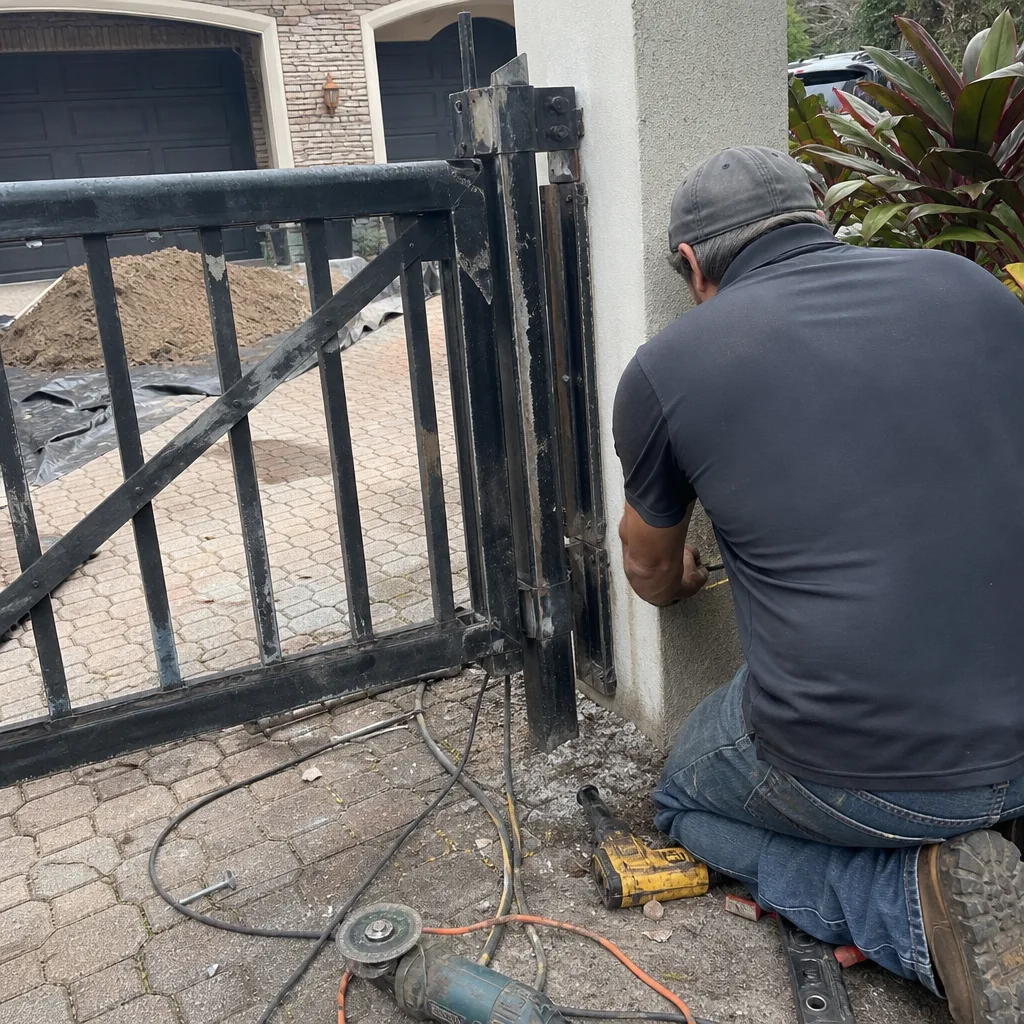 Before
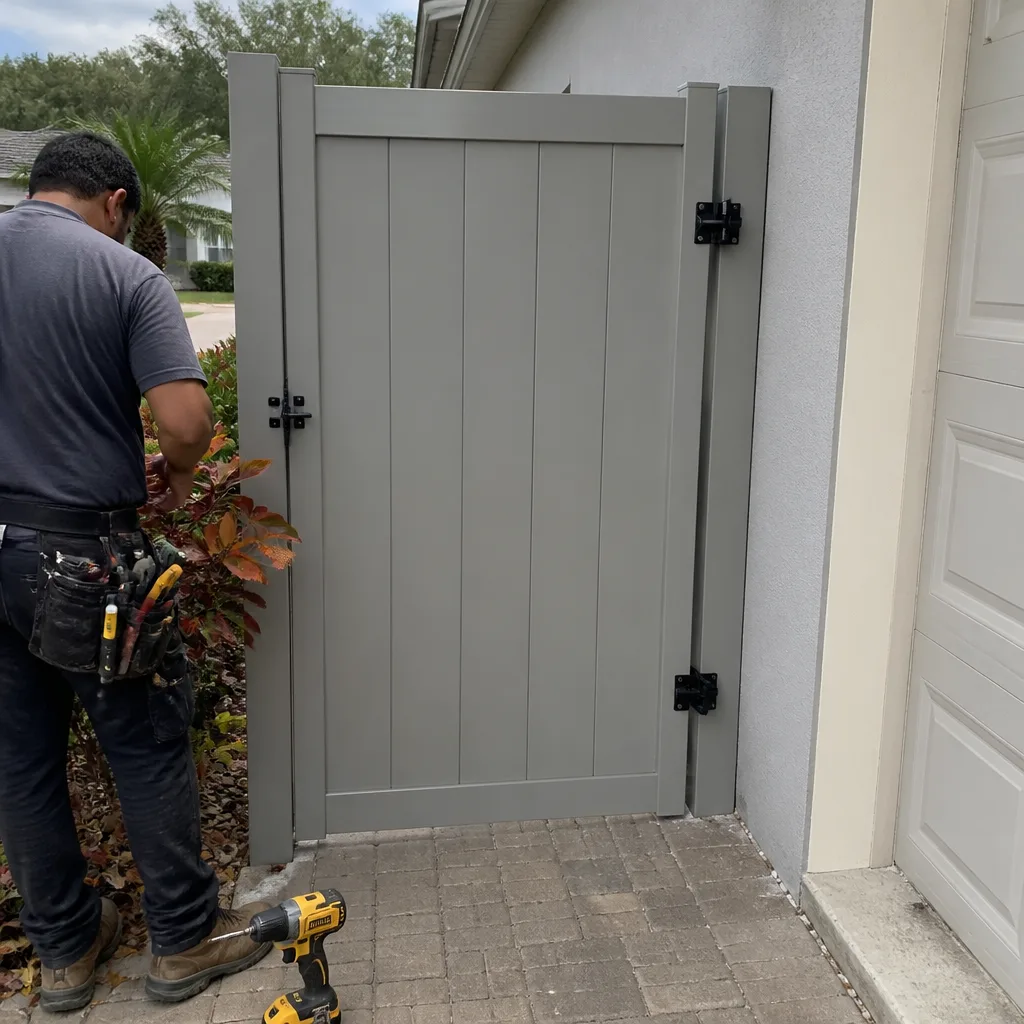 After
After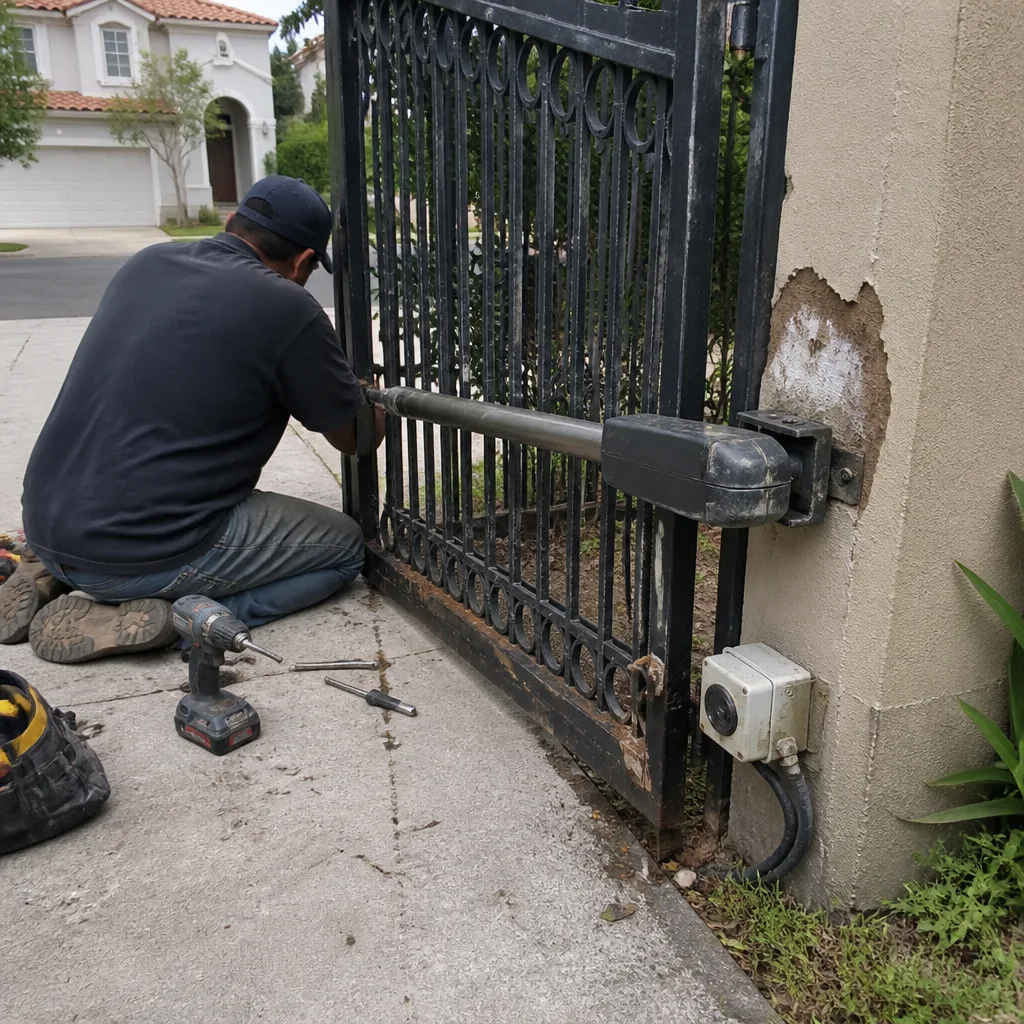 Before
 After
After Before
 After
After